↓
 

San Francisco Land Surveying

Local Land Surveyors in San Francisco, CA

San Francisco Land Surveying
  • Home
  • ALTA Survey
  • Boundary Surveying
  • Construction Survey
  • Drone LiDAR Mapping
  • Elevation Certificate
  • Land Surveying
  • Topographic Survey
  • Blog
  • Contact Us
Home 1 2 3 … 7 8 >>

Post navigation

← Older posts

Welcome to San Francisco Land Surveying

San Francisco Land Surveying Posted on August 18, 2017 by San FranciscoSurveyorApril 15, 2020

Your Final Stop for ALL of Your Survey Needs!                                         Contact us today for a free quote!

This site is intended to provide you with information on Land Surveying in the San Francisco, CA and San Francisco area of California. If you’re looking for a San Francisco Land Surveyor, you’ve come to the right place. If you’d rather talk to someone about your land surveying needs, please call our local number at (415) 200 3952 today. For more information, please continue to read.

land surveyingLand Surveyors are professionals who make precise measurements to determine the size and boundaries of a piece of real estate.  While this is a simplistic definition, boundary surveying is one of the most common types of surveying related to home and land owners. If you fall into the following categories, please click on the appropriate link for more information on that subject:

San Francisco Land Surveying services:

    1. I need to know where my property corners or property lines are. (Boundary Survey)
    2. I have a loan closing or re-finance coming up on my home in a subdivision. (Lot Survey)
    3. I need a map of my property with contour lines to show elevation differences for my architect or engineer. (Topo Survey)
    4. I’ve just been told I’m in a flood zone or I’ve been told I need an elevation certificate in order to obtain flood insurance or prove I don’t need it. (Flood Survey)
    5. I’m purchasing a lot/house in a recorded subdivision. (Lot Survey – See Boundary Survey if you’re not in a subdivision.)
    6. I’m purchasing a larger tract of land, acreage, that hasn’t been subdivided in the past. (Boundary Survey)

Contact San Francisco Land Surveying services TODAY at (415) 200 3952.

Posted in boundary surveying, elevation certificate, land surveying, land surveyor | Tagged boundary survey, land surveyor, land surveyor san-francisco ca, San Francisco Land Surveying

How a Boundary Survey Helps Property Owners Plan ADUs on Long-Established Lots

San Francisco Land Surveying Posted on June 23, 2026 by San FranciscoSurveyorJune 22, 2026
Main residence and detached backyard dwelling arranged around shared outdoor space on an older lot

Adding an ADU to an existing property sounds simple at first. There’s a backyard, there’s some open space, and the idea is to build something useful in it. But most long-established lots aren’t as straightforward as they look. Decades of additions, plantings, and outdoor projects have shaped the yard in ways that aren’t always obvious from a casual look around. Before a homeowner starts talking to a designer or pulling permit applications, a boundary survey gives them a clear picture of what they’re actually working with.

Looking Beyond the Main House Before Making Room for an ADU

Most older properties were designed around one thing, a single house for one household. The yard was landscaped for privacy or appearance, not for fitting a second unit into later. Garages went where they were convenient. Sheds got placed where there was room. None of those decisions had a future ADU in mind.

When a homeowner starts thinking about adding one, the first real question is where it can actually go. That answer depends on more than just eyeballing the backyard. Setback rules, lot dimensions, and the location of existing structures all factor into what’s allowed and what’s possible. A boundary survey establishes the actual lot lines and shows how the current layout sits within them. That gives the homeowner a real starting point instead of working off assumptions about how much space they have.

Existing Features in the Yard Can Shape Where an ADU Fits

A backyard that looks open from the kitchen window often has more going on than it appears. A concrete patio takes up one corner. A detached garage sits along the back fence. A storage shed occupies a strip near the side yard. A mature tree with a wide root zone rules out anything within fifteen feet of it. A retaining wall running across the slope means grading anything near it gets complicated fast.

Each of those features affects where a new structure can realistically go. Some of them sit closer to the property line than the owner realizes. Others might fall within setback areas that local rules protect. A boundary survey shows how all of those existing improvements relate to the actual lot lines, not just how they look relative to the house. That spatial picture is what lets an architect or designer start working with real information instead of finding out mid-project that a planned location doesn’t work.

Side Yards and Narrow Access Areas Become More Important Than Many Owners Expect

Most homeowners think about their backyard when they picture an ADU. Side yards rarely come to mind until someone points out they matter. But on a lot where a detached unit needs its own entrance, its own parking, or a path that doesn’t run through the main living space, side yards become critical. A four-foot side yard that was perfectly fine for a single residence can become a real obstacle when a second household needs to move through it every day.

Access paths, utility connections, and separation between the main house and the new unit all take up space that narrow side yards may not have. Setback requirements add another layer on top of that. A boundary survey defines exactly how wide those side yards are, where easements might limit use, and how the overall lot shape affects what’s workable. Homeowners who skip this step often find out during the permit process that their planned ADU location conflicts with rules they didn’t know applied to their specific lot.

Long-Established Lots Often Contain Layers of Improvements Added Over Time

A property that’s been lived in for thirty or forty years rarely looks the way it did when it was first built. Patios got added. Fences moved. A deck went on the back of the house sometime in the nineties. A detached workshop appeared a few years after that. Landscaping grew in, got removed, and grew back differently. The yard that exists today is the result of dozens of small decisions made across multiple decades, often by multiple owners.

That layered history creates a property layout that didn’t come from a single plan. Things sit where they sit for reasons that may no longer be obvious. A boundary survey cuts through that accumulated history and shows the current condition of the lot as it actually exists right now. For a homeowner trying to figure out what they have to work with before adding an ADU, that current picture matters more than anything from the original subdivision plat or an old listing photo.

Planning for an ADU Means Thinking About the Property as a Multi-Home Site

An ADU changes the way a property functions at a basic level. What was one household becomes two. Outdoor space that used to belong entirely to one family now needs to serve two separate living situations. Privacy between the main house and the new unit becomes a real design consideration. Parking, trash areas, utility meters, and mail delivery all need to work for both households without creating daily friction.

That shift in thinking has to start somewhere, and a boundary survey is a practical place to begin. Here’s what that survey helps homeowners think through before design work starts:

  • Where natural separation between the two units can be built into the layout
  • How outdoor space can be divided to give each household usable privacy
  • Where shared circulation paths work without cutting through private areas
  • How utility connections and service areas can be positioned to serve both units cleanly

None of those questions have good answers without an accurate picture of the lot. A boundary survey provides that picture early enough that it can actually shape the design rather than just confirm what was already decided.

Frequently Asked Questions

Why do homeowners request a boundary survey before planning an ADU? 

It gives them an accurate picture of the lot before any design or permit work begins, so decisions about placement and layout are based on real dimensions rather than estimates.

Can existing backyard features affect where an ADU can be placed? 

Yes. Structures, mature landscaping, retaining walls, and paved areas all take up space and may sit closer to property lines than the owner realizes.

Are older lots different from newer subdivisions when adding an ADU? 

Yes. Long-established properties tend to have accumulated improvements from different periods that affect how space can be used, in ways that newer lots typically don’t.

Who commonly requests a boundary survey for an ADU project? 

Homeowners, architects, designers, builders, and property investors all use boundary surveys when planning additional living space on an existing lot.

Does a boundary survey only focus on property lines? 

No. It also helps owners understand how the full lot is laid out today, which is what matters most when trying to fit a new structure into a property that’s already been built out over many years.

Posted in boundary surveying | Tagged boundary surveying

The Average Cost for a Land Survey Nobody Talks About

San Francisco Land Surveying Posted on June 12, 2026 by San FranciscoSurveyorJune 4, 2026
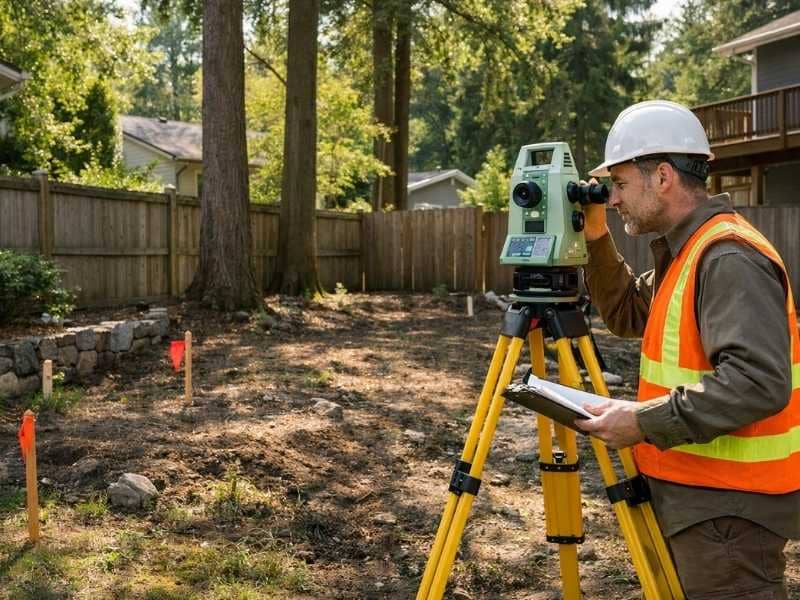
Surveyor using professional equipment on a residential property, showing factors that influence the average cost for a land survey

Most cost guides give you a number and stop there. The average cost for a land survey in San Francisco ranges from $568 to $739 based on data from over 5,500 completed projects in the area. But that number alone does not tell you much. What actually matters is why your specific project might land above or below that range, and what pricing details most homeowners never think to ask about. That is what this article covers.

How Surveyors Actually Charge for Their Work

Before looking at numbers, it helps to understand how surveyors build their prices. Most use one of two methods.

The first is a flat fee. The surveyor reviews your property details upfront and gives you a fixed price for the whole job. This is the most common approach for standard residential lots. You know the cost before work begins, and it does not change unless the scope of the job changes.

The second is an hourly rate. Surveyors charge an average of $220 to $450 per hour for fieldwork. Research to pull property records costs less, typically $85 to $160 per hour. Hourly pricing is more common on larger or more complex jobs where the surveyor cannot predict how long the work will take.

In San Francisco, most residential jobs are quoted as flat fees. But if your property has unusual characteristics, the surveyor may switch to an hourly model or add hourly charges on top of a base rate. Knowing which model applies to your quote helps you understand what you are actually agreeing to.

What the Average Cost for a Land Survey Looks Like by Property Size

Property size is one of the biggest factors in the final price. Here is how the numbers break down nationally and what that means for San Francisco properties:

  • Under half an acre: $300 to $900 nationally. San Francisco city lots typically fall in this range by size, but local rates push the actual cost to $568 to $1,500 depending on complexity.
  • One acre: $500 to $1,000 nationally for a standard boundary survey. Most San Francisco properties are far smaller than one acre, so this benchmark rarely applies directly.
  • One to ten acres: $800 to $2,500 nationally. Very few San Francisco residential properties fall in this range.
  • Larger parcels: Costs rise with size, but the per-acre rate usually drops. A 50-acre parcel may cost $70 to $140 per acre compared to several hundred per acre on a small lot.

The key point for homeowners is that local labor rates, the density of the market, and the complexity of older parcels push costs above national benchmarks even for small lots.

The Pricing Factors Most Guides Skip Over

Beyond property size, several other things affect the average cost for a land survey that rarely get explained clearly.

How many surveyors are on the crew? Some surveys require just one person. Others need a two or three-person crew to work efficiently on larger or more complex sites. More crew members mean a higher hourly rate when the job is billed that way. Always ask how the crew will be staffed when you request a quote.

Linear footage, not just square footage. Many people assume survey cost tracks with the size of the lot in square feet. In practice, surveyors often price based on the total length of the boundary lines, not the area inside them. A long, narrow lot with a large perimeter can cost more to survey than a compact square lot with the same square footage.

Vegetation and site condition. A cleared lot with good sight lines takes less time to survey. A lot with dense landscaping, overgrown edges, or structures blocking corners takes longer. In San Francisco neighborhoods with mature trees and tight lot lines, this factor comes up often.

Recertifying an existing survey. In some cases, you can have a survey that is less than five years old recertified in your name rather than ordering a brand new one. This costs significantly less than a full new survey and satisfies many lenders and title companies. It is worth asking whether your property has a recent survey on file before committing to a full project.

Weekend and off-hours work. Standard survey scheduling is during business hours on weekdays. If your project requires weekend work or a rushed schedule to meet a closing deadline, expect a premium charge on top of the base rate.

When Timing Affects the Price in San Francisco

The time of year you schedule a survey can affect both the cost and the timeline.

San Francisco does not get snow, but it does get heavy rain in the winter months. Wet conditions make some fieldwork harder and slower. Surveyors may need extra time to navigate muddy access points or wait for conditions to improve. That added time can show up in the final bill on hourly projects.

On the other hand, scheduling during a slower period can sometimes work in your favor. Survey firms are busiest in spring and early summer when real estate transactions peak. Booking during fall or winter, when demand is lower, may give you more scheduling flexibility and in some cases more competitive pricing.

For properties with significant tree cover, late autumn or early spring is also a better window. With fewer leaves on the branches, surveyors have cleaner sight lines between boundary markers. That makes the fieldwork faster and sometimes cheaper.

What Adds to the Cost After the Quote Is Given

Even on a flat-fee project, certain things can push the final invoice above the original quote. Being aware of these ahead of time helps you budget accurately.

Scope changes discovered during research. If the surveyor pulls records and finds conflicting documents, overlapping claims, or missing prior surveys, the research phase takes longer. On hourly projects, that time adds to your bill. On flat-fee projects, some surveyors will flag this and renegotiate the scope.

Additional deliverables. The base quote usually covers one stamped survey drawing. If your lender, attorney, or title company needs additional certified copies, those may carry a separate charge.

Travel and equipment fees. Surveyors based outside of San Francisco may charge mileage or travel time to reach your site. Always ask whether the quoted price includes travel when working with a firm that is not local.

Government fees. Certain types of survey work in California require documents to be filed with the county. Those filing fees are paid to the government, not the surveyor, and are not always included in the base quote.

Posted in land surveying | Tagged Land Surveying, land surveying san-francisco

Boundary Survey Cost: What Homeowners Actually Pay

San Francisco Land Surveying Posted on June 10, 2026 by San FranciscoSurveyorJune 4, 2026
Homeowner reviewing boundary survey cost with licensed surveyor and visible property line stakes

Most homeowners start looking up a boundary survey cost after something goes wrong. A neighbor builds a fence. A permit gets flagged. A home sale stalls because no one can agree on where the property line is. 

What a Boundary Survey Does

A boundary survey has one job. It finds the legal edges of your property. A surveyor locates the corner markers, takes measurements, and creates a certified document that shows exactly where your land starts and ends.

This is not the same as a topographic survey, which maps the shape and elevation of the land. And it is not the same as a general property survey, which may show buildings and other features. A boundary survey answers one specific question: where is the line?

In San Francisco, that question matters a lot. The city is dense. Lots are small. Buildings from different time periods sit right next to each other. Being off by even one foot can cause real problems when every inch of space has value.

Boundary Survey Cost in San Francisco Right Now

In San Francisco County, a standard residential boundary survey typically costs between $800 and $1,500. That range is not just about lot size. It reflects how complex the local market is.

California has some of the highest survey costs in the country. Labor is expensive. Environmental rules are strict. Land use laws are detailed. San Francisco sits at the top of even that high statewide range.

To put it in context, the same survey on a simple lot in California’s Central Valley might cost $500 to $900. San Francisco costs more because the research takes longer and the fieldwork is harder, not because the lots are bigger.

Why Boundary Surveys Cost More in San Francisco

A few things specific to San Francisco push the price above what you would pay in most other cities.

Earthquake and liquefaction zones. San Francisco is one of the most seismically active places in the country. State law requires that certain high-risk zones be mapped and investigated before construction can move forward. If your property sits in one of these zones, the surveyor may need to work with other licensed professionals to meet permit requirements. That takes more time and costs more money.

Natural hazard disclosures. California law requires sellers to tell buyers whether a home sits in an Earthquake Fault Zone or a Seismic Hazard Zone. When a boundary survey is part of a property sale, the timing of the survey sometimes has to line up with these disclosure deadlines. That can affect the scope and schedule of the work.

The Alquist-Priolo Fault Zone. California has a law called the Alquist-Priolo Earthquake Fault Zone Act. It requires sellers to tell buyers if any part of the property falls within a designated fault zone. A boundary survey is often the first step in figuring out exactly where a parcel sits relative to that zone.

Getting to the site in a dense city. Surveyors working in neighborhoods like the Mission, the Richmond, or SoMa deal with heavy traffic, limited parking, and tight access around occupied buildings. These are real costs that get built into the quote.

What Is Included in the Price

A boundary survey quote covers more than someone walking around your yard with equipment. Here is what the price normally includes:

  • Reviewing your deed and title records to confirm the legal description of your land
  • Checking recorded plats, past surveys, and county records
  • Measuring the lot and locating existing boundary markers
  • Setting new corner markers where old ones are missing or damaged
  • Creating a certified survey drawing with the surveyor’s official stamp
  • Writing a legal description of the boundary if it is needed for permits or title work

Some things are often not included in the base quote. These can include government filing fees if a Record of Survey must be filed with the county, extra copies of the certified drawing requested by lenders or lawyers, and any follow-up work needed if a boundary dispute comes out of the findings.

Always ask for a written breakdown before you agree to anything. A clear, itemized quote means the surveyor has thought through what your specific job actually involves.

When You Actually Need a Boundary Survey

A boundary survey makes sense in these situations:

  • You plan to build a fence, add a room, or put up a new structure near the edge of your property
  • A neighbor is disputing where the line falls and you need a legal document to settle it
  • You are applying for a city building permit that requires confirmed boundary information
  • You are buying a property and want to confirm the lot matches the legal description
  • You are applying for a lot line adjustment or subdivision

A boundary survey is not always needed. If you are refinancing and not doing any construction, your lender may accept an older survey or a simpler document. Knowing which type you actually need before you order one can save you real money.

How to Compare Quotes Without Getting Caught Off Guard

Getting more than one quote is a smart move. But comparing quotes takes some care. Two quotes for the same property can look very different depending on what each one covers.

When you look at quotes side by side, check whether each one covers everything your project needs. A low quote that leaves out monument setting, county filing fees, or any follow-up work will not stay low once the job starts.

Also check that the surveyor is licensed in California. The California Board for Professional Engineers, Land Surveyors, and Geologists has a free public tool to verify licenses. Only a licensed surveyor’s stamp makes the final document valid for permits, sales, and legal purposes. Without that stamp, the document has no legal standing.

Frequently Asked Questions

Does a boundary survey affect my property taxes ? 

A boundary survey on its own does not cause a tax reassessment. But if the survey shows your lot is bigger than the official record says, or if the work leads to a lot line adjustment that changes the parcel size, the assessor’s office may update the file. It is worth knowing this before the work starts, especially if the result could change your tax bill.

Can a boundary survey support a lot line adjustment application in San Francisco? 

Yes. San Francisco’s Planning Department requires a licensed survey as part of any lot line adjustment application. The boundary survey documents the existing lines before any changes are proposed. The survey must show current conditions and carry the stamp of a licensed California land surveyor.

What is a Record of Survey and when does California require one? 

A Record of Survey is a legal document filed with the county recorder’s office. It formally records the results of a boundary survey. In California, surveyors must file one when they set new markers, when their findings differ from a previously recorded survey, or when the parcel has never had a recorded survey before. Filing fees vary by county and are not part of the surveyor’s professional fee.

How does the Alquist-Priolo Earthquake Fault Zone affect a boundary survey? 

The fault zone does not change how the survey is done. But if your property is in or near one of these zones, you may face extra permitting steps before any construction can begin. A boundary survey is often the first step in figuring out where your parcel sits in relation to the zone line, and that information matters for your overall project planning.

What happens if two licensed surveyors come up with different boundary lines? 

It does happen, especially on older lots with little prior documentation. When two certified surveys conflict, the disagreement is usually resolved by reviewing the chain of title, the order of recorded documents, and the physical evidence on the ground. A licensed surveyor can document the conflict and give a professional opinion. If the two sides still cannot agree, an attorney may need to get involved.

Posted in boundary surveying | Tagged boundary survey

Post navigation

← Older posts
Get Quote Button
© Boxer Survey USA
San Francisco Land Surveying

San Francisco, California
Phone: (415) 200 3952

Web Development and SEO by:
AuburnBusiness.com, LLC


Privacy Policy | Terms of Use

The owner of this website, Boxer Survey USA, provides coordination of professional land surveying and engineering services in all 50 states. The professional surveying and engineering services provided to you will be conducted by fully licensed professionals in your state.

↑